
Generative AI
As an Artist, I Broke a Rule I'd Never Thought I'd Break. Why?
August 11, 2026 · Suellen Barnes
Artists choose different mediums; I have worked in words, paint, pencil, and images, and, after generative AI became accessible to the mainstream public in 2022 and I thoroughly studied it for a few months, I swore I would never use it as a tool with which to create. Why? Not because it was incapable of crafting eloquent strings of text or assembling whimsical, colorful lines in patterns but because, due to its neural data training set derived from humans, I decided using it would be akin to theft.
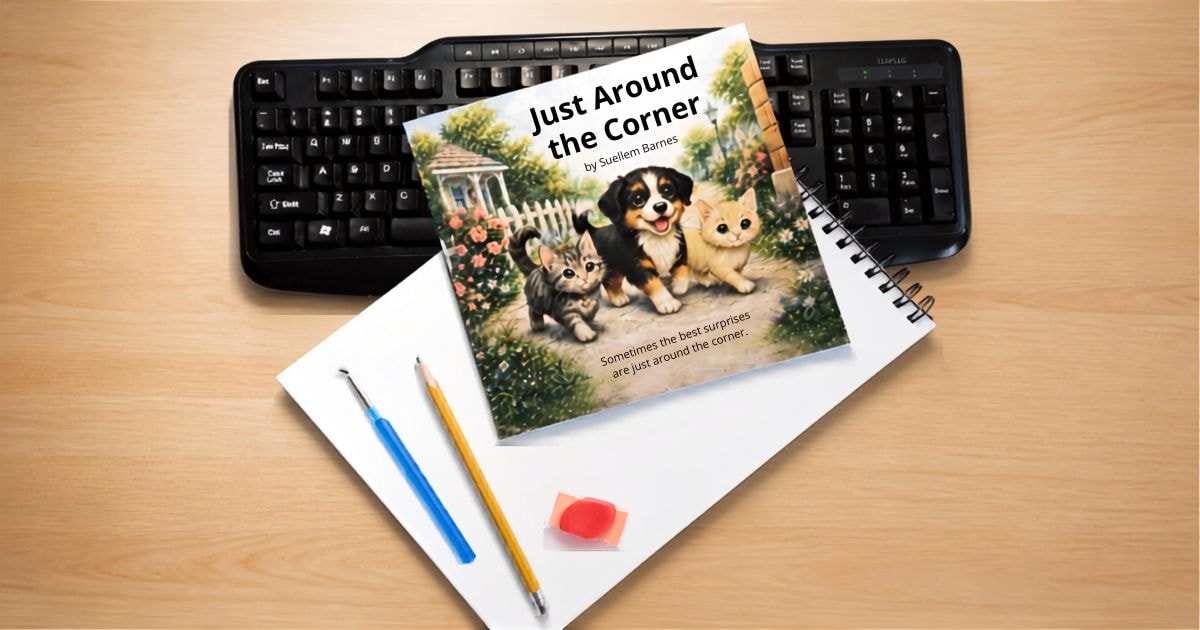
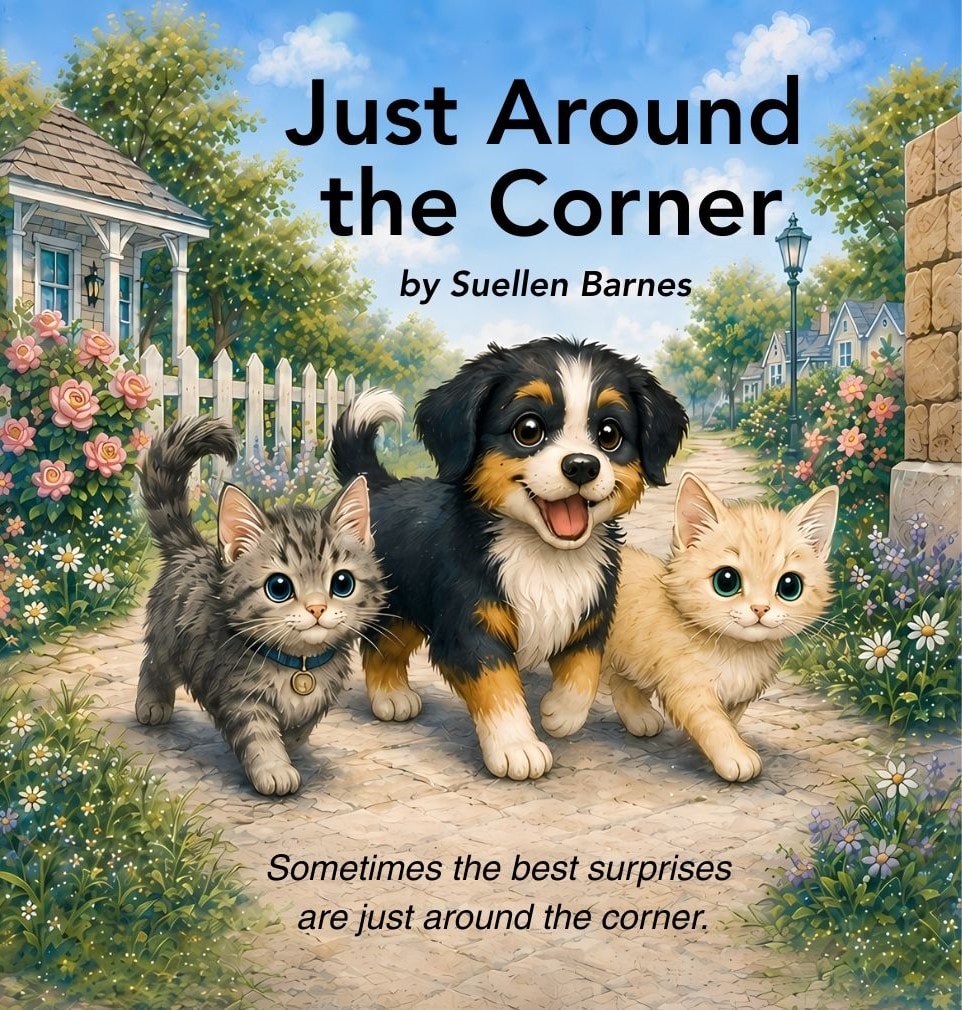
In the spring of 2026, however, after spending almost a year creating the story and writing the text of a children's book, Just Around the Corner, I changed my mind. I used generative AI to create the illustrations.
I uploaded photos of my two house cats, Gizmo and Moonshine, and my Australian Shepherd, Montana, when they were kittens and a puppy as baseline images and, over a two-month period, created hundreds of prompts to use with ChatGPT and DALL-E to edit those images and create the background scenes.
Why?
Time, money, and creative vision.
Time. I had written Just Around the Corner because I wanted to give children a story that focused on topics such as friendship, resilience, inclusion, and kindness in a fun, non-threatening, and non-preachy manner. I also wanted to give tired caregivers a simple story to read aloud that easily settled their kids down to sleep. I had completed the story in late April, but I wanted it available mid-summer. I sell flowers I raise on my farm in late summer and fall, and I included a flower farmer in the book. This all meant I had about two months to complete the illustrations in order to self-publish on time.
Of course, at first, I considered hiring a human artist. I reviewed the work of tens of artists but did not find someone whose work, availability, timeline, and cost all fit what I needed for this particular project. Based on the artists and processes I researched, I also knew that completing an entire picture book could take considerably longer than the two months I had available. So I decided to revisit, although reluctantly at first, the idea of using AI.
Money. Since I planned to self-publish and had no certainty of how much revenue the book might make, I did not want to spend two to four thousand dollars on artwork before knowing whether the book would ever earn that money back. This was not going to be a vanity project; I wanted to provide a fine product that achieved what I wanted and could be used as a fun learning tool by teachers and caregivers, but I did not want to go into debt producing it.
That did not mean I thought a human artist's work was not worth the cost. It meant I could not justify that level of speculative expense for this particular self-published book, with its limited budget and very short production schedule. Since I have paid several hundred dollars in ChatGPT fees during the past few years and had only used it for a few minor projects, I decided I'd like to start getting a return on my fees. This project was a good start.
Creativity. I have written articles and books in the past; I have taken tens of photos for our farm site, barnesdalefarm.com; and I have sketched and painted various commercial works, including our newest farm sign. I did not use AI to create any of those projects. I did not need AI as a tool at those times to achieve my artistic vision.
What I slowly learned, however, after about a month of working on the illustrations using AI as a tool and a workmate, was that I did need this tool this time. I began to see glimpses of what I envisioned the illustrations should ideally look like — the way I distinctly wanted them to appear.
And this was where my original objection to AI became more complicated.
I had not suddenly decided that my concerns about how generative AI was trained were meaningless. I still understood that these systems were built using enormous amounts of human-created material, and I remained uncomfortable with some of the ethical questions surrounding that process. What changed was my belief that refusing to use AI at all was the only reasonable response to those concerns.
I began to see a distinction between asking AI to replace my creative thinking and using it as a tool through which I could exercise that thinking. I supplied the original animal photographs. I determined the characters, scenes, expressions, composition, emotional tone, and story. I rejected images, revised images, changed proportions, corrected expressions, altered backgrounds, adjusted colors, and created hundreds of prompts trying to make what appeared on the screen match what already existed in my mind.
Sometimes it worked beautifully.
Sometimes it absolutely did not.
ChatGPT's responses during that process also caused me to see something in how the illustrations were progressing that I would never have been able to see previously.
I am, unfortunately, a perfectionist.
After about five weeks, our conversations repeatedly returned to the possibility that I would ultimately be giving up artistic vision if I continued to demand consistency in every aspect of the design. I fought with ChatGPT every time I identified an aspect of a character's image that was too small or too big. I demanded adjustment when another character's expression did not adequately reflect the emotion associated with a particular scene. I even considered, at one point, consulting another AI program in an effort to achieve even more consistency.
The problem was that I had observed a slight drift in the style of the last three illustrations.
Then I sat back and reconsidered the advice I had received about giving up artistic vision for consistency.
The truth was that I loved what ChatGPT, DALL-E, and I had created together. The characters that had appeared in my mind now appeared before me digitally.
Could the slight drift represent something else?
The style was not bad; it almost had an ethereal note. I simply did not appreciate that it was different until I considered whether that slight change might subtly represent the character arc of the story.
The primary character was different at the end.
To be frank, all of the characters were different at the end.
They were all a little happier and part of a more content, hopeful, cohesive group. The ethereal change might communicate this improvement subtly to a child's eyes.
When the conversation once again reflected back to me just how much of a perfectionist I had become — and how much I had acted like a strict artistic director throughout the project — I finally decided the advice was right.
I needed to stop.
The work was done.
And it had been done in a unique way that emerged from the interaction between the technology and the artistic decisions I made while using it.
Do I recognize that the systems I used were trained on data sets containing the products of human artists? Yes.
Do I admit that using AI as a creative tool can eliminate some opportunities for human creators? Absolutely.
Those concerns did not disappear because I found AI useful. Nor do I think artists who object to generative AI are simply standing in the way of progress. Many of their concerns deserve serious consideration.
But I would offer that a hybrid view of the future may be more useful than requiring ourselves to choose between two absolute positions.
If I can use AI as a tool to produce a unique project according to unusually specific guidelines, within a budget and timeline I could realistically manage, and create a learning tool for teachers, parents, guardians, and friends to use to help young children develop traits that may help them live better lives, then perhaps that project does not have to represent a rejection of human artists.
In fact, if it enables me to make a modest profit and continue creating, I may be in a better position to hire human artists for future projects that do not have the same limitations.
I no longer think the question is simply whether artists should embrace AI or fight it.
The more useful question may be how we use it without allowing it to make human creativity irrelevant.
Maybe the answer is not entirely human or entirely AI.
Maybe we need to think outside of the box and develop a hybrid strategy that enables humans and AI to create alongside each other — sometimes together and at other times independently — while continuing to recognize, protect, and value the distinctly human creativity from which all of this began.
Now Available
Just Around the Corner
The children's book at the heart of this essay — a story about friendship, resilience, and the courage to take one brave step. Illustrated with AI, directed entirely by Suellen.
Learn more about the book